


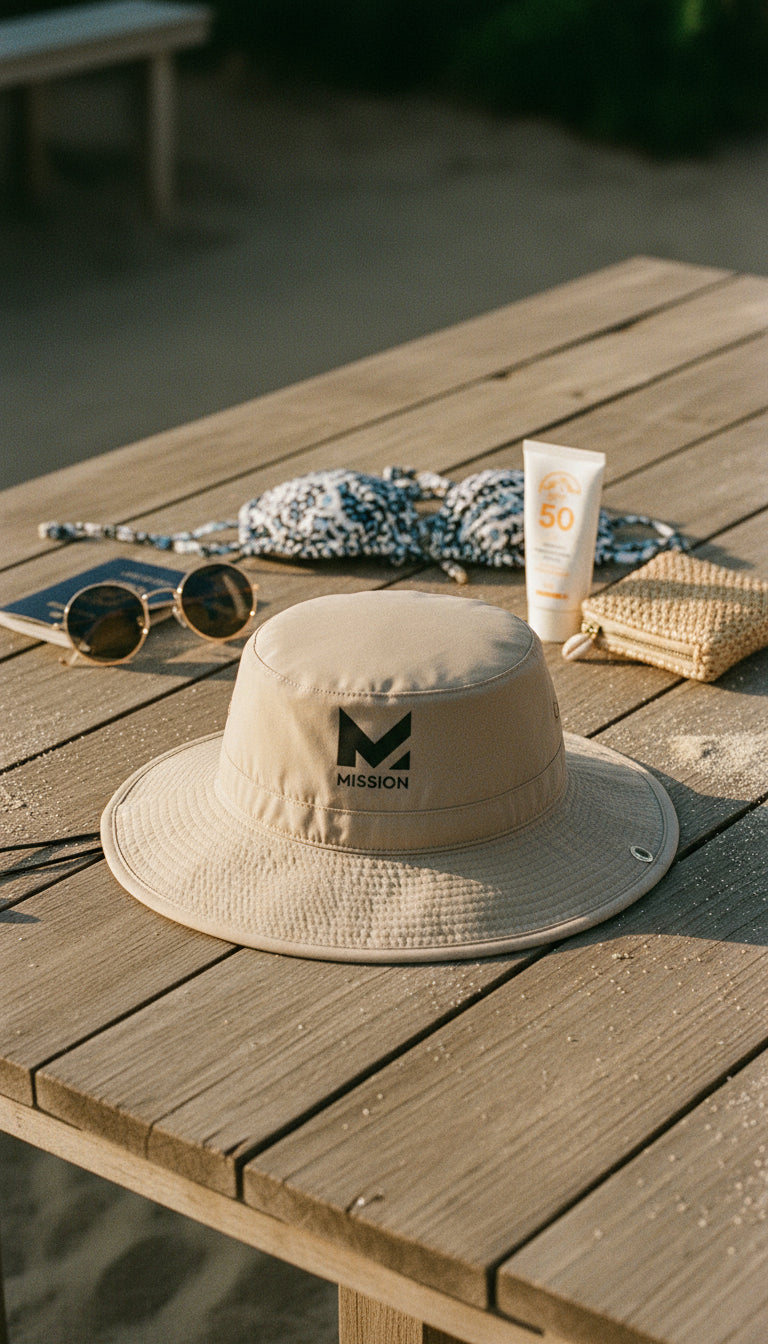
You've probably seen "UPF 50" on a shirt tag or hat and wondered whether it actually means anything, or if it's just another number brands like to throw around. It's a fair question. Sunscreen has SPF, the weather app has a UV index, and now your clothes have a rating too. Here's what UPF really measures, why the number matters, and how to tell genuine sun-protective gear from a regular tee that happens to have a label.
UPF, defined
UPF stands for Ultraviolet Protection Factor. It's a rating for fabric, and it tells you how much of the sun's ultraviolet radiation a piece of clothing blocks from reaching your skin. The higher the number, the less UV gets through.
The good news? The math is actually pretty simple. A fabric rated UPF 50 allows just 1/50th of UV radiation to pass through it, meaning it blocks about 98% of the sun's rays. A UPF 30 fabric blocks roughly 96.7%, letting 1/30th through. Once you cross UPF 50, the differences get small enough that most rating systems simply label the top tier "UPF 50+."
For comparison, your favorite old cotton t-shirt probably offers a UPF closer to 5, and even less once it's wet or stretched. That's the difference between a barrier built to protect you and one that happens to be in the way.
UPF vs. SPF: same goal, different jobs
People use the two terms interchangeably, but they measure different things.
SPF — Sun Protection Factor — applies to sunscreen. It estimates how much longer it takes UVB rays to redden protected skin compared to bare skin. SPF is about a product you apply, and its protection fades as you sweat, swim, and forget to reapply.
UPF applies to fabric, and it accounts for both UVA and UVB rays, the full spectrum that damages skin. The big advantage is consistency. A UPF 50 hat doesn't wear off at the two-hour mark or rinse away in the ocean. As long as you're wearing it, it's working. The American Academy of Dermatology consistently points to clothing as one of the most reliable forms of sun protection precisely because it doesn't depend on perfect application.
The best approach isn't choosing one or the other. It's using both. UPF clothing to cover as much skin as possible, and broad-spectrum sunscreen for the parts you can't cover, like your face, ears, and the backs of your hands.
What actually makes a fabric sun-protective
Not every garment earns a high UPF rating, and the number isn't random, it comes from standardized lab testing (the widely used U.S. standard is ASTM D6603). A few factors determine how a fabric scores:
• Weave density. Tightly woven or knit fabrics leave fewer gaps for UV to slip through. Hold a shirt up to a light; if you can see through it easily, the sun can get through too.
• Color. Darker, more saturated colors tend to absorb more UV than pale ones.
• Fabric type. Synthetics like polyester and nylon naturally block more UV than untreated cotton.
• Fit and stretch. Fabric stretched tight over skin opens up its weave and lets more UV through, which is why a snug, thin shirt can underperform its rating.
This is why a tested UPF 50 garment gives you something a random t-shirt can't: a verified, consistent level of protection that holds up across a full day outside.
Why coverage beats reapplication
The case for sun-protective clothing comes down to reliability. The Skin Cancer Foundation notes that most people apply far less sunscreen than the amount used in testing, and most forget to reapply on schedule. Clothing closes that gap. You put it on once, and the coverage stays put on the trail, on the job site, or three hours into a round of golf.
It also covers the spots that are easiest to miss. The back of the neck, the tops of the shoulders, and the forearms take a beating in direct sun and rarely get a second coat of sunscreen. A long-sleeve UPF 50 shirt or a pair of sun sleeves handles all of it without a single reapplication.
How MISSION builds protection in
At MISSION, UPF 50 isn't a finishing treatment that washes out over time, it's engineered into the fabric, blocking 98% of UVA and UVB rays. And because our gear is built on chemical-free evaporative cooling technology, it does two jobs at once: shielding your skin while actively pulling heat away from your body. Wet the fabric, wring it out, wave it, and it cools, then keeps cooling as you sweat.
Here's the catch with a lot of sun protection gear: the more coverage you add, the hotter you get. Covering up to block UV often means overheating. MISSION gear is designed so you can do both, stay covered and stay cool across hats, neck gaiters, sun sleeves, and performance shirts .
The bottom line
UPF 50 is a real, tested measure of how much sun your clothing keeps off your skin and at the top of the scale, that's about 98% of UV rays, all day, without reapplying anything. Pair it with sunscreen on exposed skin and a little shade during peak hours, and you've built genuine, low-effort sun protection into your routine.
Ready to feel the difference? Explore MISSION's UPF 50 cooling gear and stay covered, cool, and comfortable wherever the day takes you.